6.11.2009
מילונים, a.k.a., words and books combined into deliciousness


| מילה בלועזית | תרגום בעברית | מילה חדשה |
| passenger van | רכב המיועד להסעת 8–12 נוסעים ומטענם | סָעוֹן |
| מיני ואן | מכונית גדולה המיועדת להסעת 5–8 נוסעים ומטענם. בתקנות התעבורה מכונה רֶכֶב פְּרָטִי דּוּ-שִׁמּוּשִׁי | סְעוֹנִית |
| GPS navigator | התקן מערכת איכון המשמש לניווּט | נַוְטָן |
| GPS locator | התקן מערכת איכון המשמש לזיהוי מקום | אַכָּן |
| passenger capacity/limit | מספר האנשים המרבי שרכב יכול להכיל; לרוב בתחבורה ציבורית | דְּחֻסָּה |
| "שאטל" | כלי תחבורה המסיע נוסעים ממקום מסוים ואליו, לעתים תכופות או באופן סדיר ובדרך כלל אינו חלק ממערכת הת"ץ הסדירה | הֶסֵּעִית |
| "ח'אפֶּר" | רכב לא מורשה הנוסע במסלול של תחבורה ציבורית סדירה ו"חוטף" את הנוסעים מתחנות השירות הציבורי | חַטְפָנִית |
| [There is no word for this in English as far as I know.] | התקן המציג מסר בכתב או בסמל התקֵף בעת הארתו. למשל: סמל של סיגריה ועליו פס ביטול או סמל של חגורת בטיחות | מַזְהֵר. רבים: מַזְהֲרִים. |
| רמפה | כביש חיבור המשמש למעבר בין שתי דרכים באותו מחלף; | מֶחְבָּר |
| [I have no idea what this is] | רכב מסחרי לא-אחוד, מכונה טֶנְדֶּר | מִטְעָנִית |
| moving sidewalk | רצועה הנעה לאטה בהינע חשמלי המאפשרת לאנשים לעמוד עליה או ללכת עליה כדי לעבור ממקום למקום. בשימוש בנמלי תעופה | מַסּוֹעַ לֶכֶת |
| delivery van | רכב מסחרי אחוד | מִשְׁלוֹחִית |
| [merging and its opposite—dividing?; I don't think there's one word for this in English] | התמזגות והיפרדות סמוכות מאוד של כלי רכב הנוסעים באותו כיוון בכביש | הִשְׁתַּזְּרוּת |
Labels: books/reading, Hebrew, Israel, words

5.25.2009
Speaks for itself

- the idea
- the title
- the graphic layout
Labels: books/reading, Israel
8.20.2008
Suicide on college campuses and thinking about long-term career options
Anyone who wants to read more on the topic can start with College of the Overwhelmed, by Richard Kadison and Theresa Foy DiGeronimo. I know Richard Kadison and was interviewed for the book.
I was very active in mental health advocacy in college, mostly on behalf of students to deans, advisers, and other university staff. I also worked on reducing stigma in the student population, and served as an informal resource for a lot of students who wanted to seek help for their mental health concerns and didn't know where to turn. I really miss that work. It was the first public speaking that I ever felt comfortable with. I thought that I might make a career out of it at one point, but I didn't get the one job that I applied for in that field, so, instead, I ended up doing something else for the last five years. (I did get an interview, though, which felt promising at the time.)
Part of me still feels drawn to some kind of career in public health/urban planning/environmentalism/anti-domestic violence. I don't know exactly how all of those things intersect in my brain, but they do, in interesting ways. For me, it basically boils down to this: People should live in environments (both macro and micro) that support their full potential as human beings and that allow them to be supportive members of larger communities, while engaging their minds and bodies fully, and in a way that is sustainable in the long term. That's the life that I want to lead and that I want everyone around me to lead. Now, how can we make that happen? I know it's a tall order, but I think it has to do both with how people interact on a micro level and how cities are designed and built on a macro level. Who gets to think and learn and write about this stuff, and how can I sign up?
I worry, sometimes, about getting fully sucked up into the wonderful world of Jewish learning, and setting aside all of these other nascent interests that I have, that have not-very-much to do with gemara or halakhah.
Labels: books/reading, mental health, science/health/environment
12.26.2007
Reading Rainbow and other TV shows you may miss from your childhood in the 1980s!
I don't think that this show made me enjoy reading any more than I would have otherwise, though, in respect to my earlier post about why some people become avid readers and others don't. My brother watched the show with me and he never became an avid reader by any definition. Both of my sisters are avid readers like I am. That breakdown might suggest that it is a gender thing, but my father read a lot, as did both of my grandfathers.
While you're at it, here is the intro to 3-2-1 Contact (why does Wikipedia call it a "reality" show, though?), although the part I remember starts from the middle of this video. Here are some snippets from the actual show. I haven't had time to watch them, because I've been engrossed in Square One TV. See below.
Here is the intro to Square One, although it was nothing special in my memory and my memory was apparently correct. Much more enticingly, there are many little snippets of Square One TV on YouTube. I think I spent a whole afternoon watching them once. So, go have fun! I remember many of the songs fondly.
This is one of my favorites from Square One, but I think it's more my favorite now than it was when I was a kid. It has taken on new meaning since 1990! (Also, the '80s-ness of it just kills me.)
"Magic Number Nine" and "Tesselations" were two of my favorites as a kid. Come on, admit it, you like songs about math, too!
(Parenthetical tangent: Note that I don't discriminate. I also like songs about reading. For example, I am quite fond of Tom Lehrer's songs "Silent E" and "L-Y." Especially "L-Y." That's a great song. You may remember them from The Electric Company, but I am just six months or a year too young to remember it. It stopped airing in reruns in 1985, when I was 5 and 6 years old. I remember a lot of things from when I was five and six (the Challenger disaster, the summit meeting between Reagan and Gorbachev), but not this show. I am also about six months too young to remember when Snuffleupagus went from being imaginary to being real. This also happened when I was six, but I guess I always remembered him as being real because I kept watching the show for awhile after that. (I watched nothing but public television until I was 9, and because I had younger siblings, I probably watched Sesame Street and Mister Rogers for longer than some peers.) Classmates who were born six months before me definitely remembered him being imaginary. It's funny to think of what I remember and what I don't remember from when I was between the ages of, say, 4 and 7. After I was 7, I think I remembered a lot more.)
Good Lord, you can also watch Mathman all over again! I loved those! Maybe even more than the music videos, with the notable exceptions of "Magic Number Nine" and "Tesselations." Without further ado, some Mathman (much more available on YouTube):
Likewise, I don't think that all that watching of Square One made me like math any more than I would have otherwise. For years, I was both afraid of and hated math even though, based on things I've learned about myself since I stopped studying math formally (about halfway through 12th grade) would indicate that I probably have some natural aptitude for math.
It would be a tautology to say that I never liked math because of my fear and hatred, but I think it's safe to say that if I had not been afraid of and hated math, then I might have gotten good at it and thus learned to like it. Between sixth grade and twelfth grade I moved, more or less against my will, from the lowest math group into AP Calculus, but math was never a happy subject for me, unlike, say, English, history, Talmud, biology, or art appreciation. I learned some statistics from a book and thus managed to place out of the math requirement in college, but another placement test I took my freshman year indicated that if I were to take math in college, I would have to take remedial algebra, i.e., relearn whatever it was I learned (or didn't learn) in 9th and 11th grades. (I think 10th grade was geometry, which I aced and also sort of enjoyed. Proofs! Yay! What fun!) Numbers still fluster and scare me to some extent, and I wish they didn't. The real question is: Why was I afraid of numbers when I was as young as 6? I think I know the answer, but I'll save that for another post.
Labels: books/reading, childhood, fun 'n games, gender
12.08.2007
Why do you read?
Why am I reading the New York Times from two weeks ago? In my last apartment, we all split daily delivery of the New York Times, which came to our door (very cheaply--my New York City public school teacher roommate got the $15/month rate), and I managed to read parts of the Sunday, Tuesday, and Thursday papers on most weeks. Now that I don't get it delivered, and only buy it when I really, actively, want to read it, I find that every other Sunday New York Times is about all I have time for. One week to read the magazine; another week to read the other sections that I'm most interested in. What's the difference? I spend more time commuting to and from work, I donated to the UJA-Federation and started getting the Jewish Week, which I read parts of most weeks, and I'm reading more fiction, I think. Of those three factors, the only one I'm really enjoying is reading more fiction. I really miss reading the Science Times and every other Sunday paper, but I almost never remember to buy the newspaper on Tuesday and I feel silly buying a new Sunday paper when I haven't even finished the last one. The obvious solution would be to read online, but I don't like reading entire sections of the paper online.
So, back to books, the topic of the aforelinked article. Why do some people become "enduring readers," as the article calls them? What made me become an enduring reader?
Apparently, although my parents are also big readers, that is not enough. I do think that, in my case, everyone reading on Shabbat evenings and afternoons made me want to read books. I distinctly remember the first book that I read on my own (Pat the Bunny, or perhaps the later Pat the Cat), and the context in which I read it: Everyone else is my family was reading, nobody wanted to play with me, and I wanted to be reading like they were. So I did. Huzzah! I wonder if, isolated from economic and educational status and other things that affect reading, people who observe Shabbat in the traditional way read more than people who don't. I'm fairly sure that people who observe Shabbat in the traditional way play a lot more board games than people who don't. I grew up playing board games (Candyland, Aggravation, Rack-O, Life, Monopoly) every Shabbat, and, even now, when spending Shabbat and holidays with my family, we often crack open a deck of cards or Rummikub. How many Americans do that?
Back to reading. I don't remember it taking very long for me to move from picture books to Cam Jansen, Encyclopedia Brown, Ramona Quimby, Little House on the Prairie, Anne of Green Gables, Betsy, Tacy, and Tib, books by Robert Newton Peck, Paula Danziger, Lois Lowry, and Judy Blume and many, many more). I also read "lesser" literature such as Sweet Valley Twins and The Babysitters' Club. (I think that's a fine thing. It didn't corrupt my brain. I still enjoy reading what most literary types consider "junk," and I often avoid reading what others consider "good literature." I do feel a little bit overly defensive about this, though.)
The article suggests that for some, one book read in childhood triggers a love of reading, but I don't think that was the case for me. I don't remember ever not loving reading. I always loved escaping into other worlds, real worlds not my own, through reading. I went through a phase, or maybe two separate phases, when all I wanted to read were biographies and auto-biographies. There was a whole wall in the children's section of the local public library devoted to a series of easy biographies for kids. Most of them were of people like George Washington, Abe Lincoln, Hellen Keller, George Washington Carver, and Martha Washington. I guess you could call them iconic Americans.
One thing that the article said struck a chord: "But what makes that one book a trigger for continuous reading? For some, it’s the discovery that a book’s character is like you, or thinks and feels like you."
I think part of what I always loved about reading was that I almost always identified, in some way, with the book's character. I'm not sure right now how I would have identified with George or Martha Washington, but I think that, to some degree, these children's biographies were written to promote identification between the reader and the subject. Perhaps part of the joy of reading is that it enables me to identify with a character who is wholly unlike me in every way. And yet, still, I get to inhabit her world for a little bit, feel her feelings, let her people become my people. All without leaving the comfort of my own home (or subway car, as the case may be)!
Yes, I think that's it. I think that also explains why I sometimes feel very sad when I finish a good book. It's like being booted out of a place that temporarily became my life. Television and movies don't do that to me in the same way.
Anyway, go and read the article. It's a good read!
Labels: books/reading
5.17.2007
If you think sharing an apartment with two or three roommates is hard...
Other things I've been meaning to share but not gotten around to yet:
- In February, Doctor Mama wrote a post called "Why Ask Why?" that I loved. It's about our constant need to try to find reasons for things, and how we handle it when there is no reason to be found.
- Also from February, Dr. Barbara Ehrenreich's take on "think positive, be passionate, smile all the time" advice given by business gurus. I have liked Barbara Ehrenreich since I read her For Her Own Good: 100 Years of the Experts' Advice to Women (written with Deirdre English and first published in 1978) when I was in high school. It was an interesting book and my first real exposure to gender studies and its application to history. I didn't read her book Nickel and Dimed, but I read the January 1999 Harper's Magazine article on which the book is based. I found the article to be thought-provoking and the book is probably only more so. The premise is that she tries to live on a minimum wage and finds it basically impossible.
- Speaking of how easy or difficult it may be to live as a poor person in America today, here is the blog of a woman in San Francisco, named Rebecca Blood, who is trying to eat all organic food on a food stamp budget. She's not actually on a food stamp budget; she's just doing it to see if she can. I know that I wouldn't be able to.
- Speaking of spending minimal amounts on food but still trying to eat decently, here is a post from Half-Changed World about one woman's attempt to feed her family on the USDA's Thrifty Food Plan in January 2005. (Here [pdf] is the 2006 version, published in April 2007.) In case you hadn't heard of it (as I had not), the USDA's Center for Nutrition Policy and Promotion website says of the plan: "The Thrifty Food Plan, the basis for maximum food stamp allotments, is a nutritious, minimal-cost diet." For background, here is Half-Changed World's introductory post to the problems of poverty and obesity.
- Huh. This is turning into a post about poverty and food, under the guise of sharing a Manhattan co-op with chickens. Interesting. So, while you're at it (or even before you read all of that stuff above), read Michael Pollan's column ("You Are What You Grow") from the New York Times Magazine on April 22 about the upcoming US farm bill and the way groceries are priced in the US, due to corn subsidies and other nefarious practices. He does an excellent job of answering the question: "So how is it that today the people with the least amount of money to spend on food are the ones most likely to be overweight?" I know from my own experiences, that when I went to buy cranberry juice in the grocery store, it was either $5-$6 for a little bottle of 100% juice, or $3 for a bottle of "juice" in which the very first ingredient was corn syrup. (I ended up not buying it at all.)
- Here is an old news story from January about hareidim in Israel burning what they deem to be immodest women's clothing. It's old news, but I didn't get a chance to write about it before. The photo is disturbing. Is that a hareidi guy using a havdalah candle to burn women's clothing? That seems particularly sick. Can't they sew up the slits, give clothing that's tight to smaller women or pre-teens, etc.? Add material? Kick pleats, anyone? I mean, is burning clothing really the best way to handle this? SephardiLady over at Orthonomics said this much better than I ever could awhile ago. I want to write more, much more, about tsniut [the Jewish concept of modesty] sometime, but don't have the guts/energy/oomph to do so now.
- Finally, on a lighter note, go to cringebook.com if you want to:
Share [your] old diaries, journals, letters, notes, songs, poems... anything you wrote during the crushing misery of adolescence and then saved in a hidden box at your parents' house all these years. Top secret no more.
Oh, it looks like they are no longer taking submissions. Oh, well. The book will be out in Spring 2008 and you can then revel in the knowledge that other adolescents (and pre-adolescents) also had crushing, miserable experiences growing up.
The more dramatic, embarrassing or excruciating the writing, the better. A good test to determine whether or not your material is Cringe-worthy: when you read it to yourself, do you physically cringe? Then for the love of god, it needs to be in this book. Seriously. You are going to be so glad you did this. Cheaper and better than therapy.
Special thanks to everyone who voted for me in the JIB awards! It looks like I came in third place (bronze?) for Best Personal Blog. Yay!
Labels: books/reading, links, New York, real estate, science/health/environment
4.06.2007
"Maybe Eliyahu will come tomorrow..."
Anyway, to sum up the first four days of Pesach Passover, I've compiled this list. This is one of those annoying blog posts to read, unless you're my parents, because it is basically a "What I did on my summer vacation" fifth grade style essay, only in list form. C'est la vie.
- Most heartbreaking moment: Seeing a three-year-old's hopes and dreams get crushed as the grown-ups, once again, perpetuate a lie.
At the second seder I attended, there was a three year old girl, SW. She and her two older brothers (ages 7 and 11) were all sweet and well-behaved, for the most part. I think it was the first seder in which SW could actively participate. All of the kids had taken long naps and were planning on staying up throughout most of the seder. SW just wanted to stay up until dessert. Then she wanted to stay up for bentching [Grace After Meals]. Finally, she said that she just wanted to stay up for Eliyahu [Elijah the Prophet]'s visit, only she kept calling him "Eliya" without the final sylable. Her 11 year old brother, AW, said to her as they went to the door, "You know that Eliyahu is invisible, don't you?" She nodded affirmatively. But she clearly didn't, because she went into hysterics as soon as the front door was closed and her parents cheerfully said, "Okay, Eliyahu came, now it's time for bed!" She wailed, "But I want to see Eliyahu! Eliyahu didn't come yet!" Shoot. No kidding. Her father bundled her up to bed and later reported that as she was falling asleep, she said, "Maybe Eliya will come tomorrow..." - Best overall Pesach-related Pesach experience: Leading the first seder.
I led one seder last year, too, and what can I say? I like leading things. I like being in charge. Most of all, I liked the feeling of responsibility that it gave me. It pushed me to read Judith's Hauptman's "How Old is the Haggadah?" (JUDAISM, Winter 2002) and at least the first half of Joshua Kulp's "The Origins of the Seder and Haggadah" (Currents in Biblical Research, Vol. 4, No. 1, 109-134, 2005). I finished Kulp's article last night. I also read through selections from Midrash Rabbah on Shemot, looking for interesting things. I was able to share two or three short new ideas, which made me very happy. - Best consumer experience: Going to Cody's Books in San Francisco yesterday (the perfect day!).
In short, I purchased R' Baruch Epstein's Haggadah/Commentary on Pirkei Avot (actually, it's a reprint of 2/3 of Baruch She'Amar) for $3.99. Alas, this morning's paper said that Cody's Books is going to have to close its San Francisco location (the second Berkeley store will stay open; the first closed last May). One more terrific independent bookstore bites the dust.
There were a few great things about this experience. I was planning on walking from the CalTrain station to my friend EBC's apartment in Russian Hill, which is about a 2.5 mile walk according to publicroutes.com (new website I found that gives walking routes! but I would never plan a route ahead of time, since there are fewer things more lovely than traipsing around a moderately unfamiliar city with nothing but a map and my wits). It was absolutely gorgeous out. In a moment that will surely go down in history, I managed to resist the temptation to buy, oh, about five other books that I looked at (none of which were full price, but all of which were more than 50% of full price--i.e., an unreasonable amount to pay--and none of which I need, of course). Finally, I went to the remaindered table, and after looking through every other book there, I found this haggadah. And it's perfect not just because I happen to like haggadot, and not just because it cost $3.99 in a bookstore chock full of tempting $24.99 hardcovers and $13.99 paperbacks, but because it also includes a commentary on Pirkei Avot, which I studied (religiously) between Pesach and Shavuot for a year or two, but then grew tired of. In it's final perfectness, the outside of this haggadah is pretty--a light, cream-colored background with gold lettering. Who could ask for anything more?
The rest of yesterday was also pretty fantastic. Before my lucky find at Cody's Books, I walked through the park at Yerba Buena Gardens. After my lucky find, I walked up Stockston Street to Union Square, and eventually made it to Grace Cathedral. From there, I walked up Leavenworth Street, which has some lovely views of the bay, including Alcatraz. Apparently, I also climbed Nob Hill. I knew it was very hilly, just not that it was Nob Hill. EBC told me. Anyway, it was a great San Francisco day. Once I got to EBC's place, I reacquainted myself with her daughter C by doing a puzzlewithfor her and by reading her two Madeline books while she cuddled up next to me, and met her new baby daughter H. Madeline books are the best! After the kids went down for their naps, I gave and received the annual update. Then I took the lazy route (bus) back to the CalTrain station through Chinatown and the train back to my grandmother's. - Most guilt-inducing eat: Veal.
I don't buy veal. (Actually, I don't buy any red meat, but veal is the only red meat I won't buy out of principle. The rest I don't buy because it's expensive, fairly unhealthy, and I don't know how to cook it. Plus, I'd much rather get my saturated fat from ice cream than from beef. No contest.) You all know, of course, that veal is created by penning up baby animals in tight spaces and not letting them move around much so that their meat stays soft and tender and yummy for us to eat. It's not very nice. If you're going to kill an animal to eat it, you should at least treat it decently while it's alive. And it's true that I'm a bit of a hypocrite and don't only buy free-range eggs and chickens, which I would if I was a good person, but since I hardly buy any eggs or chickens these days, I think God will forgive me. All my kale, whole grains, and tofu are 100% free range. But the veal was served to me at one seder, and my God, was it delicious! And I will probably eat it again tonight. Once I've fallen, does it really matter if I fall again? Thank you to my kind aunt who made it and even made an alternative for those who don't eat veal (like me). Only I do eat veal, apparently. This is why I am a flexitarian instead of a vegetarian or even a pescatarian. Meat tastes too damn good. - Most guilt-inducing read: Cosmopolitan.
The magazine. Yeah. I know. My excuse is that I bought it for my little sister, who put in a request from Israel. I wonder how many other people sat down the second day of Pesach with Midrash Rabbah, Cosmo, "The Origins of the Seder and Haggadah" (Currents in Biblical Research, Vol. 4, No. 1, 109-134, 2005), and a literary novel (as opposed to, say, romance novel or mystery)? I picked up The Worst Day of My Life, So Far from the hefker ("free stuff") table at my building. The novel is pretty depressing (it's about a woman who returns home to the rural South to care for her mother who has Alzheimer's), so I haven't gotten that far in it. I mean, look at what it's competing with! Cosmo and Midrash Rabbah!
Labels: books/reading, childhood, life, travel
3.13.2007
On and off my bookshelf
 I have to update those reading lists on the side. In the past few weeks, I've finished five books, three of which I read so quickly that they never made it onto the list of books currently being read at all. I started these between December and a few days ago, so don't go thinking that I read the entirety of each of these books in the past few weeks.
- Turbulent Souls: A Catholic Son's Return to His Jewish Family, by Stephen J. Dubner
I enjoyed this. It was a little bit slow going at first, but once I got into it, it was a quick read. I remember that when I read Herman Wouk's This is My God as a teenager, it reminded me why I like being Jewish so much. Turbulent Souls had a similar effect. I've also long had a soft spot in my heart for autobiographies and other stories that people choose to tell about their lives. When they are good story-tellers, I find it fascinating. Stephen Dubner is a good story-teller. (I went through a phase when I was 7-12 or so where I mostly read autobiographies and biographies. I went through the whole stack of kids' biographes at the library1 and then moved on to Candice Bergen's autobiography and Katharine Hepburn's autobiography. That's how I originally got into her movies.)
- Freakanomics: A Rogue Economist Explores the Hidden Side of Everything, by Steven D. Levitt and Stephen J. Dubner
You probably know all about this book already. Once I got into it (recurring pattern here?), I read a chapter every night until it was done. Then I read through the appendices. It was fun. If you liked this, you'd probably also enjoy their blog. I find that it's volume is too high for me to keep up with, so I usually don't read it at all, but if I had unlimited time, I'd read it!
- The Kid: What Happened After My Boyfriend and I Decided to Go Get Pregnant, by Dan Savage
Short book and an interesting look into what the adoption process was like for two gay men who decided to do an open adoption. I found the open adoption part more interesting than the two gay men part, frankly.
- The Glass Lake, by Maeve Binchy
This is the kind of fiction that I really love reading. Some people might find that surprising (since I use big words and don't own a television? I dunno). I used to even read proper romance novels, but they lost their, um, novelty after awhile and got boring and repetitive. I think of trade paperback fiction like they're my soap operas or something. I get really into these sorts of books very quickly and rip right through them, reading at least 100 pages at a sitting. This one was 750 pages and I started it at 6 pm one Friday night and finished it by 8 pm the next evening. Ah, Shabbos! I used to do this all the time when I was a kid and decided I no longer liked shul--read straight through Shabbat. Now I'm mostly more responsible and community-oriented, so I do things like make meals, go to meals, go to shul, etc. Once in awhile, though, when I'm exhausted, this is a delicious luxury. Yum. Read, eat, read, sleep, read, eat, sleep, read...
- The Pilot's Wife, by Anita Shreve
I picked this up on the "hefker table" in my building's lobby. People leave books that they no longer want, and that's my main source for junky fiction. (I usually put the books back after I'm done reading them, since I am unlikely to reread these kinds of books.) This wasn't a trade paperback, so maybe it can be considered less junky than The Glass Lake, but it also wasn't high fiction or, well, hard on the brain. It was okay and fine entertainment, but I didn't enjoy it as much as The Glass Lake.
Next up? Maybe The Bastard on the Couch: 27 Men Try Really Hard to Explain Their Feelings About Love, Loss, Fatherhood, and Freedom, edited by Daniel Jones. Lest you find that title offensive (and you may be right to find it so), there is also a book called The Bitch in the House: 26 Women Tell the Truth About Sex, Solitude, Work, Motherhood, and Marriage, edited by Cathi Hanauer, who also wrote the foreword to The Bastard on the Couch. I think they were published as a pair. (Update: Bitch in the House was compiled by Cathi Hanauer first, and Bastard on the Couch was put together by her husband.) I'm less interested in Bitch, though, since I already know what women think. Or at least what one woman thinks. Also, I'm sort of tired of reading about motherhood in the media. What about fatherhood?
---------------------------------------
1. I think they were something like these, but not this exact series. I remember reading about George Washington Carver and Betsy Ross, and they aren't included in this particular series. Oh, and I think Abraham Lincoln, too. My mother once told me that I didn't learn anything in school in 2nd grade, but it was okay because I read a ton of books that year. I'm sure some large percentage of the random stuff that I know today, I learned from reading those easy reader biographies in second grade and from watching 3-2-1 Contact.
Labels: books/reading
3.09.2007
Sibling abuse bibliography
American Psychiatric Association. “Authorities Should Increase Vigilance for Sibling Abuse,” Psychiatric News, October 2, 1998.
Asherman, Lee I. And Ellen J. Safier. "Sibling Incest: A Consquence of Individual and Family Dysfunction." Bulletin of the Menninger Clinic. Summer 1990. 54(3). 311-322.
Ferrer, Millie and Sara McCrea. “Sibling Rivalry.” Document FCS 2132, one of a series of the Department of Family, Youth and Community Sciences, Florida Cooperative Extension Service, Institute of Food and Agricultural Sciences, University of Florida, June 1999. [The 1999 version is no longer available online, because it was reviewed and updated in June 2002, after I wrote this paper. See the 2002 version at http://edis.ifas.ufl.edu/pdffiles/HE/HE11000.pdf.]
Frazier, Billie H and Kathleen C. Hayes. "Selected Resources on Sibling Abuse: An Annotated Bibliography for Researchers, Educators, and Consumers." University of Maryland, CES. October 1994, http://www.cyfernet.org/research/sibabuse.html.
Gelles, Richard J. Intimate Violence in Families. 3rd ed. Thousand Oaks, CA: Sage Publications. 1997.
Green, Arthur S. "Child Abuse by Siblings." Child Abuse and Neglect. 1984. 8: 311-317.
Iowa State University, "Understanding Abuse: Sibling Abuse," University Extension: Ames, Iowa, Reprinted October 1994, http://www.extension.iastate.edu/Publications/PM1478X8.pdf.
Kiegelmann, Mechthild. Coming to terms: a qualitative study of six women's experiences of breaking the silence about brother-sister incest. Thesis (Ed. D.)--Harvard Graduate School of Education, 1997.
Kiegelmann, Mechthild. More than just playing doctor: a review of psychological literature on women's experiences on [i.e. of] brother-sister incest. Qualifying paper--Harvard Graduate School of Education, 1995.
Kochakian, Mary Jo. "How to Spot and Deal with Sibling Abuse." Palm Beach Post. October 22, 1992, Section: Accent, pg. 3D.
Pfouts, J.J., J.H. Schopler, and H.D. Henley, "Forgotten Victims of Family Violence." Social Work. July 1982. 27(4). 367-368.
Rayment, Susan and Nicole Owen. "Working With Individuals and Families Where Sibling Incest has Occurred: The Dynamics, Dilemmas and Practice Implications." A paper presented at the Children and Crime: Victims and Offenders Conference convened by the Australian Institute of Criminology, Brisbane, June 17-18 1999, http://www.aic.gov.au/conferences/children/owen.pdf.
Snyder, Howard. "Sexual Assault of Young Children as Reported to Law Enforcement: Victim, Incident, and Offender Characteristics: A Statistical Report Using Data from the National Incident-Based Reporting System." National Center for Juvenile Justice. July 2000. NCJ 182990.
Steinmetz, S.J. "A Cross-Cultural Comparison of Sibling Violence," International Journal of Family Psychiatry. 1981. 2 (3/4): 337-351.
Strauss, Murray A. and Richard J. Gelles, eds. Family Violence in American Families: Risk Factors and Adaptations to Violence in 8, 145 Families. New Brunswick, NY: Transaction Publishers, 1990.
University of Michigan Medical School, "Sibling Abuse." Your Child: Development and Behavior Resources: A Guide to Information and Support for Parents, http://
Wiehe, Vernon R. Sibling abuse: hidden physical, emotional, and sexual trauma. 2nd ed. Thousand Oaks, Calif.: Sage Publications, c 1997.
These are the sources that I found useful when writing my paper in 2002. It looks like there is a much more extensive bibliography here.
Labels: books/reading, mental health
1.10.2007
The demise of the independent bookstore
The Abstract and the Particular
Ruined by Reading
 I'm tempted to largely agree with her reasoning, even though I do have a very special place in my heart for small, independently-owned shops of all kinds. I love independent bookstores, and I try to purchase books in the following order, all other things being equal. (Sometimes other factors come into play, such as how desperately I need the book, how short I am on money, or where I happen to be geographically.)
- used from an independent bookstore
- used from Amazon
- new from an independent bookstore
- new from Amazon
- new from Barnes & Noble or Borders
All of this, of course, is a moot point, since I'm trying to stop buying books entirely mostly due to lack of space. (Money plays a role, too, but if you get used to the price of a latte at Starbucks, books don't seem like so much in comparison, especially purchased used.) I find the library to be more trouble than it's worth most of the time, since it closes at 6 pm on most nights and isn't open at all on Sunday. Since I already own a lot of books that I haven't read, I'm trying to read those rather than take other books out of the library or purchase more books. Sometimes I can't help myself, though...
In other news, I think I just chipped a tooth. With my tongue, I feel a new rough spot along the top of one front bottom tooth that definitely felt different before, but my teeth look fine in the mirror. Should I be worried? Is this what I have to look forward to as I age?
Labels: books/reading, New York
12.31.2006
Book plug
I just finished reading It's Called a Breakup Because It's Broken: The Smart Girl's Breakup Buddy, by Greg Behrendt & Amiira Ruotola-Behrendt, and I want to highly recommend it to anyone who has either recently broken up with someone, or not-so-recently broken up with someone but is having trouble "getting over it." This is a fun, easy read that will tell you the things that you need to hear to move on. I'm not a huge fan of self-help literature (at least not contemporary self-help literature--I took a great class my freshman year in college on the origen of the genre). But this book was good. So good that I'm breaching the rarely-breached public/private divide that I maintain on this blog to plug a book that will tell you something about my private life.
Go get 'em, Superfox! That is all I have to say about that part of 2006.
May 2007 bring health, happiness, gratitude, joy, peace, fulfilling work, good friends, and loving family to all!
Labels: books/reading, life
11.10.2006
Men, Women, and Height
Until recently, I don't think I realized how much being short affects men's self-esteem. (It might even be analogous to how being overweight affects women's self-esteem.) I don't think it ever really mattered to me how tall people were, but maybe that's because I'm 5'8". Mostly, I like being tall because it makes it easier to reach things that are high up, thus effectively giving me more usable storage space. Otherwise I don't think about it much, except to feel grateful that there's really no reason for me to ever wear high heels in an attempt to appear taller.
I remember seeing a photo of myself with a 5'1" friend in high school, and I was shocked at how I towered over her, since in regular interactions with her, I'd always felt that we were close in height. When I told her how surprised I was by our difference in height, she indicated that she was not surprised at all, and that every time we spoke, she was aware of how much taller I was. So maybe, in a way, height matters more to short people than to tall people--it affects their self-image more than tall people's height affects theirs. It wasn't hard to be a tall adolescent, although I actually started out at around 5'2" in seventh grade (thus, short) and then just kept growing an average of an inch a year through senior year. It was a little bit hard to be bigger than my female friends once since they all stopped growing around 7th/8th/9th grade at 5'1" or 5'2" and I just kept shooting up. I wasn't overweight in high school as much as big--tall and broad. I couldn't share or trade size 2, 4, or 6 clothing with the other girls. If someone was staying over and had to borrow something--say, pajamas--they would be ridiculously large on her. It felt somewhat mortifying at the time.
I wonder, after reading the book review, if the benefits that apparently fall into the laps of tall men also benefit tall women, if height makes no difference for women, or if the reverse is somehow true. Am I paid more than shorter women? Do people respect me more? Would I be more likely to win an election? I have found in the dating world that some men who are 5'5" or 5'6" (or shorter) don't really want anything to do with me. They're adamant that they must end up with a woman shorter than they. I, on the other hand, would be fine with a man shorter than I. This would seem to be a disadvantage to being a tall woman, although as a wise friend pointed out, a man who won't date a woman because she is a few inches taller than him is not someone I would want to date anyway. It's a pretty easy way to weed out people who have other issues that would make us incompatible.
Finally, in August, two Princeton-based researchers published a paper ("Stature and Status: Height, Ability, and Labor Market Outcomes") suggesting that taller people fare better economically because they're smarter. Abstract available here. PDF of entire paper available for download here. One (short) blogger's reaction here. I'm not sure what I think about that, although it doesn't seem like a very nice thing to say. The book review I read last Sunday suggested that human beings evolved towards larger brains and greater intelligence because they were smaller than other mammals in their environment. I.e., smaller species that survive do so because of greater intelligence. Not that that says much about the correlation between an individual's height and intelligence, but, still, it may make the shorter people feel better.
Labels: books/reading, gender
8.22.2006
Childhood television and books
 I would strongly consider raising my (future, hypothetical) children without television. I think that there are lots better ways to spend one's time, and they're going to spend enough time staring nearly-passively at a [computer] screen as it is. (I wouldn't be averse to having a small-to-mid-sized monitor and NetFlix, though.)
However, I must say that reading these blog posts about Mr. Rogers' Neighborhood and Sesame Street, and other things that parents remember from their childhood that they want to share with their children was very nice. Heck, I don't even have kids, and I've already blogged about Sesame Street,
 so I can't blame these folks who actually have kids. If you're a Fred Rogers fan, you might especially enjoy reading this, although the photo there is a bit creepy. I think he was, um, younger when I watched. (Also regarding the photo on this post, I don't think he wore running shoes when I watched him. I think he changed into and out of canvas sneakers.)
On a related note, I recently had a conversation with an acquaintance about books that were read to me as a child. The topic came up because he was looking for things to read to his five year old daughter. We came up with the following, as appropriate to be read to a five year old. What did we miss?
- A Cricket in Time Square
- All of a Kind Family
- Betsy, Tacy, and Tib series (probably more fun to read herself)
- Dr. Doolittle (note that there is the original racist version and a cleaned-up version)
- Freddy the pig books
- James and the Giant Peach
- My Father's Dragon
- Pippi Longstocking
- Stuart Little
- The Borrowers
- The Ramona books (probably more fun to read herself)
- Through the Looking Glass
- Winnie the Pooh
Labels: books/reading, childhood
5.24.2006
100 Most Frequently Challenged Books, 1990-2000
 "Banned Books Week" was most recently observed last September, but I say, never blog today what can be put off until tomorrow, so this is only appearing now. I thought that the list, below, of "most frequently challenged books" was interesting. Some of them kind of make sense to me in that they seem inappropriate for young children; others, not so much. I wonder how different the books from 2000-2010 will look. Will there be...ack!...science textbooks on the list? (Click here for the 10 most challenged books in 2005, including the ever-popular Catcher in the Rye.)
The ones that are in bold typeface are the ones that I remember reading, but I think I might have read more of these than that. There are definitely many authors listed here whose other books I've read.
The 100 Most Frequently Challenged Books of 1990–2000
- Scary Stories (Series) by Alvin Schwartz
- Daddy’s Roommate by Michael Willhoite
- I Know Why the Caged Bird Sings by Maya Angelou
- The Chocolate War by Robert Cormier
- The Adventures of Huckleberry Finn by Mark Twain
- Of Mice and Men by John Steinbeck
- Harry Potter (Series) by J.K. Rowling
- Forever by Judy Blume
- Bridge to Terabithia by Katherine Paterson
- Alice (Series) by Phyllis Reynolds Naylor
- Heather Has Two Mommies by Leslea Newman
- My Brother Sam is Dead by James Lincoln Collier and Christopher Collier
- The Catcher in the Rye by J.D. Salinger
- The Giver by Lois Lowry
- It’s Perfectly Normal by Robie Harris
- Goosebumps (Series) by R.L. Stine
- A Day No Pigs Would Die by Robert Newton Peck
- The Color Purple by Alice Walker
- Sex by Madonna
- Earth’s Children (Series) by Jean M. Auel
- The Great Gilly Hopkins by Katherine Paterson
- A Wrinkle in Time by Madeleine L’Engle
- Go Ask Alice by Anonymous
- Fallen Angels by Walter Dean Myers
- In the Night Kitchen by Maurice Sendak
- The Stupids (Series) by Harry Allard
- The Witches by Roald Dahl
- The New Joy of Gay Sex by Charles Silverstein
- Anastasia Krupnik (Series) by Lois Lowry
- The Goats by Brock Cole
- Kaffir Boy by Mark Mathabane
- Blubber by Judy Blume
- Killing Mr. Griffin by Lois Duncan
- Halloween ABC by Eve Merriam
- We All Fall Down by Robert Cormier
- Final Exit by Derek Humphry
- The Handmaid’s Tale by Margaret Atwood
- Julie of the Wolves by Jean Craighead George
- The Bluest Eye by Toni Morrison
- What’s Happening to my Body? Book for Girls: A Growing-Up Guide for Parents & Daughters by Lynda Madaras
- To Kill a Mockingbird by Harper Lee
- Beloved by Toni Morrison
- The Outsiders by S.E. Hinton
- The Pigman by Paul Zindel
- Bumps in the Night by Harry Allard
- Deenie by Judy Blume
- Flowers for Algernon by Daniel Keyes
- Annie on my Mind by Nancy Garden
- The Boy Who Lost His Face by Louis Sachar
- Cross Your Fingers, Spit in Your Hat by Alvin Schwartz
- A Light in the Attic by Shel Silverstein
- Brave New World by Aldous Huxley
- Sleeping Beauty Trilogy by A.N. Roquelaure (Anne Rice)
- Asking About Sex and Growing Up by Joanna Cole
- Cujo by Stephen King
- James and the Giant Peach by Roald Dahl
- The Anarchist Cookbook by William Powell
- Boys and Sex by Wardell Pomeroy
- Ordinary People by Judith Guest
- American Psycho by Bret Easton Ellis
- What’s Happening to my Body? Book for Boys: A Growing-Up Guide for Parents & Sons by Lynda Madaras
- Are You There, God? It’s Me, Margaret by Judy Blume
- Crazy Lady by Jane Conly
- Athletic Shorts by Chris Crutcher
- Fade by Robert Cormier
- Guess What? by Mem Fox
- The House of Spirits by Isabel Allende
- The Face on the Milk Carton by Caroline Cooney
- Slaughterhouse-Five by Kurt Vonnegut
- Lord of the Flies by William Golding
- Native Son by Richard Wright
- Women on Top: How Real Life Has Changed Women’s Fantasies by Nancy Friday
- Curses, Hexes and Spells by Daniel Cohen
- Jack by A.M. Homes
- Bless Me, Ultima by Rudolfo A. Anaya
- Where Did I Come From? by Peter Mayle
- Carrie by Stephen King
- Tiger Eyes by Judy Blume
- On My Honor by Marion Dane Bauer
- Arizona Kid by Ron Koertge
- Family Secrets by Norma Klein
- Mommy Laid An Egg by Babette Cole
- The Dead Zone by Stephen King
- The Adventures of Tom Sawyer by Mark Twain
- Song of Solomon by Toni Morrison
- Always Running by Luis Rodriguez
- Private Parts by Howard Stern
- Where’s Waldo? by Martin Hanford
- Summer of My German Soldier by Bette Greene
- Little Black Sambo by Helen Bannerman
- Pillars of the Earth by Ken Follett
- Running Loose by Chris Crutcher
- Sex Education by Jenny Davis
- The Drowning of Stephen Jones by Bette Greene
- Girls and Sex by Wardell Pomeroy
- How to Eat Fried Worms by Thomas Rockwell
- View from the Cherry Tree by Willo Davis Roberts
- The Headless Cupid by Zilpha Keatley Snyder
- The Terrorist by Caroline Cooney
- Jump Ship to Freedom by James Lincoln Collier and Christopher Collier
Labels: books/reading
1.29.2006
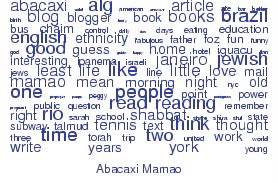
Word Cloud
 (Hat tip to Persephone and Jody.)
This word cloud illustrates the frequency with which various words appear in my blog. It's heavily skewed by the Brazil posts. (For example: Brazil, hotel, Foz, Iguacu, Janeiro, Rio, Ipanema, tennis--do these words appear outside of the Brazil posts? Well, maybe tennis does.)
I am happy that "people," "good," "love," "book," "books," "read," and "reading" are all high up there. Books and reading would be even higher if it was smart enough to count "book" and "books" as one word, and "read" and "reading" as one word. Also, "Shabbat" makes an appearance, as do "Talmud" and "Torah," although I would not put those high up there in terms of what this blog is about. "Shabbat" may have mostly been mentioned in connection with Brazil as well. I sure do wish that the word "fun" were larger!
This word cloud reminds me of something that was tacked onto the bulletin board in Sharon Steiff, z"l's English classroom. It looked a lot like the word cloud above, but with letters of the alphabet instead of words from a blog. The size of the letters illustrated how often they appear in the English language. Such a thing would be very helpful to have while appearing as a contestant on Wheel of Fortune. And it was fun to look at, too. Not that I was ever bored in English class in junior high. Never!
"Ms. Steiff," as I called her from 1991-1997, was my English teacher in 7th and 8th grade. This past Thursday was the second anniversary of her death on the Gregorian calendar. I learned a lot from her, although I didn't realize it at the time. I also had the good fortune to work with her in the spring of 2000, when I still called her "Ms. Steiff," because she was a formidable woman and I was scared to call her Sharon.
Labels: books/reading, In Memoriam, meta, words
12.20.2005
Public libraries and the Internet
 It's no joke--I haven't been to a public library in six weeks, which is a very long dry stretch for me! (Except for a month or so before I move, when I don't set foot in a library for fear of losing a book in the move, I usually go to the library regularly.) It's just that lately, the library is never open when I have time to go. The local library is open from 10 am to 6 pm most days, and until 8 pm on Tuesdays. That's still too early for me to get there most weeks. It's not open on Sunday at all, and the Saturday hours don't help me much. I don't blame the library, though. They don't have enough money to stay open more. I blame the state and the city for not providing better funding. I would pay $5/month more in taxes if it meant that the library was (were?) open more.
That's it! I'm becoming an associate of the library! There, now I feel much better. At least I'm doing something...
So I don't go to the library much these days. I do most of my reading on the Internet. Even when I wrote a paper for my library science class, we were supposed to get all of our sources from various electronic databases--I didn't do any research in the physical library, although the resources were provided by the library. The New York Public Library is no different in terms of resources available online. In addition to their Digital Library, they have all of these electronic databases. You can even search their entire catalog in Hebrew, from your very own home! (I think that's mostly for searching for things from their Dorot Division.)
It's an interesting philosophical question--where is the library if so many of its resources are available online and if working people can't go because it's never open? Will the brick and mortar library be replaced by the library-on-the-Internet? It sometimes appears that way. Would that be a good thing? I think I would miss physical libraries if they disappeared. I once went into the NYPL to use one of their electronic resources and I sat in a room full of computers, with other people tip-tapping away next to me...and it was kind of sad. Not like the somber, stately reading rooms of yore. I'm no luddite by any means, but I sure do love paper books.
Labels: books/reading
12.14.2005
The nation's most literate cities, 2005
Seattle, WA
Minneapolis, MN
Washington, DC
Atlanta, GA
San Francisco, CA
Denver, CO
Boston, MA
Pittsburgh, PA
Cincinnati, OH
St. Paul, MN
I am actually not so surprised that Boston made it but New York did not. Of course, an anecdote does not make a fact, but during my working days in Boston, I noticed that almost everyone on the T* was reading (either a book or a newspaper). The same was not true on the buses, for various reasons. Fewer people read on the subway in New York City, even though there are still a fair number of people reading. I also noticed that six of the ten cities get really cold in the winter, although they are not the coldest cities in the US by any means. I wonder if that has anything to do with it?
The ranking was slightly different in 2004, when the previous study on this subject was done.
If you go to the links on the left side of the page for the 2005 study, you'll also find out interesting things like the ten American cities with the most booksellers. I was very surprised that Boston did not make that list, or New York, for that matter. (Even though fewer people seem to read here, there are a lot of bookstores. Or so I thought. I guess if it's calculated per capita that probably works against New York.) On the same page, you'll find this associated "factoid":
The presence of retail book stores is positively associated with quality of libraries. So, it is not a question of whether people buy books or check them out: they do both or neither.Anyway, I'll leave the rest for you to explore. Hint: All the fun factoids are gathered in one place here.
Hat tip to CNet News, a.k.a. news.com.com!
*When I first moved to New York City, I kept calling the subway the "T," much to the amusement of my native New York friends. I still sometimes do, when I'm tired enough.
Labels: books/reading
7.18.2005
On the Harry Potter Bandwagon
I guess it's pretty clear that they changed the text for the American edition. I saw some references to "soccer" and was surprised. I kind of like those Britishisms (is that a word?) and missed them. Were there queues or engaged telephones in Harry Potter?
In summary, I can see why people like the books, but I can't exactly see why they go so crazy over them. (Don't shoot me.) I mean, are they that much better than other good books? Or are there so few (new) good books out there that it's necessary to go nuts over them? What's up with waiting in line at midnight for them?
Labels: books/reading


