1.08.2008
Chodesh Shevat tov! !חדש שְבָט טוב
Etymology
- From Akkadian shabatu, meaning "the month of destroying rain," from the verb shabatu, meaning "to beat, kill, destroy." It is related to a Hebrew verb that means "to strike, smite," which is also the source of the Hebrew noun shevet, meaning "rod" or "staff" and hence "tribe." Cool!
Biblical names
- "the eleventh month"
- Called "Shevat" in Zechariah 1:7, where Zechariah was given a very nice prophecy (see later verses, below):
- 15th of Shevat, in Hebrew Tu B'Shevat: the New Year for the Trees. Used for calculating special offerings taken from trees after three years of bearing fruit, only after which their fruit may be eaten.
1 Shevat - Moses begins speaking to the Children of Israel towards the end of their forty-year sojourn in the wilderness (see Deuteronomy 1:3)
2 Shevat - Hasmonean King Alexander Jannaeus (aka Yannai), a Sadducee, died on this day in 76 BCE. The Rabbis (i.e., Pharisees) declared it a holiday. See Megillat Taanit. (Interesting note: Upon his death, he was succeeded as monarch by his wife, Shlomtzion Hamalka. Among other things, she merited having a street named after her in Jerusalem.)
25 Shevat - Death of Rabbi Israel Lipkin of Salant, aka Rabbi Yisroel Salanter, in 1883, founder of the Mussar movement
Other cultures
- "Şubat" is the name for the month of February in Turkish.
According to the Sefer Yetzirah, the following correspond to the month of Shevat:
- Letter: tzadi
- Color: blue-green
- Jewish zodiac sign: pail (The New Year of Trees of the month of Shevat is the time that the rain waters of the winter months begin to ascend in the veins of the tree and bring it new life. The ascent of water in general is represented by the pail.)
- Tribe: Asher
- Sense: eating, taste
- Controlling organ/limb: stomach, esophagus
Labels: Hebrew, Rosh Chodesh, Torah (broadly defined), words

11.12.2007
Chodesh Kislev tov! !חדש כִסְלֵו טוב
Tonight is the third night of the Hebrew month of Kislev (כִסְלֵו), and this is part 3 of an occasional series. It's shorter than some of the others, because, well, I didn't have as much material. Feel free to add to it in the comments!
Etymology
- From Akkadian kislimu or kisliwu
- "the ninth month"
- Called "Kislev" in Zechariah 7:1 and Nehemiah 1:1, respectively:
א וַיְהִי בִּשְׁנַת אַרְבַּע, לְדָרְיָוֶשׁ הַמֶּלֶךְ; הָיָה דְבַר-ה' אֶל-זְכַרְיָה, בְּאַרְבָּעָה לַחֹדֶשׁ הַתְּשִׁעִי--בְּכִסְלֵו. 1 And it came to pass in the fourth year of king Darius, that the word of the LORD came unto Zechariah in the fourth day of the ninth month, even in Chislev.
- 25th of Kislev to the 2nd of Tevet: the holiday of Hanukah
- Letter: samech (ס)
- Color: blue-violet
- Zodiac sign: bow (the bow of the Maccabees)
- Tribe: Benjamin (בִּנְיָמִין)
- Sense: sleep (now this is one I can get behind! mmmm....sleep....Kislev is a very sleepy month, come to think of it)
- Controlling organ/limb: belly
Today is also the day that some people observe Veterans' Day. Thank you to all of the veterans of the armed forces who sacrifice so much in their service to this country.
Labels: Hebrew, Rosh Chodesh, Torah (broadly defined), words
8.15.2007
Chodesh Elul tov! !חדש אֱלוּל טוב
Etymology
- From Akkadian ululu or elulu, meaning "the time when [the produce of the land] is brought in," i.e. "harvest time," from a verb meaning "to bring in" or "thrust in"
- "the sixth month"
- Called "Elul" in Nehemiah 6:15:
טו וַתִּשְׁלַם, הַחוֹמָה, בְּעֶשְׂרִים וַחֲמִשָּׁה, לֶאֱלוּל--לַחֲמִשִּׁים וּשְׁנַיִם, יוֹם. 15 So the wall was finished in the twenty and fifth day of the month Elul, in fifty and two days. - A rabbinic tradition derives the source of the name Elul from part of a verse in Song of Songs (6:3):
"Ani L'Dodi v'Dodi Li," "I am my beloved and my beloved is mine." The first letter of each of these words in Hebrew spells "Elul." This is interpreted as describing the relationship between God and His people during this auspicious time preceding Rosh Hashanah.ג אֲנִי לְדוֹדִי וְדוֹדִי לִי, הָרֹעֶה בַּשּׁוֹשַׁנִּים. 3 I am my beloved's, and my beloved is mine, that feedeth among the lilies.' - Another rabbinic tradition derives the source of the name Elul from part of a verse in Esther (9:22):
Ish L'Rei'eihu UMatanot L'Evyonim," "Sending portions one to another, and gifts to the poor." The first letter of each of these words in Hebrew spells "Elul." The connection between this verse and the month of Elul is that we are supposed to increase our good deeds during this month. (I'm not a huge fan of this one, but since I just heard it for the first time this past Shabbat, I thought I would include it.)
- Because it precedes Rosh Hashanah and Yom Kippur, the month of Elul became connected to repentance.
- There is a custom of sounding the shofar daily during the month of Elul, as well as reciting Psalm 27.
- There is a Sephardic tradition of reciting selichot, or special penitential prayers, early every morning during entire the month of Elul. (Ashkenazi Jews recite selichot as well, but start only about a week before Rosh Hashanah.)
- Is it customary to begin or end all letters written during the month of Elul with wishes that the recipient have a good year. The standard blessing is "K'tiva V'Hatima Tova" ("A good writing and sealing [of judgement]"), meaning that the person should be written and sealed in the Book of Life for a good year.
- On the 25th of Elul, the Israelites rebuilt the destroyed walls of Jerusalem under the prophet Nehemiah's direction after they returned from the diaspora of Babylon (Nehemiah 6:15).
- Eylul is also the name for September in Turkish.
- Letter: yud (י)
- Zodiac sign: virgin
One explanation is that the virgin symbolizes G-d's beloved bride, Israel, the bride of the Song of Songs who says to her groom, "I am to my beloved and my beloved is to me." Another explanation that it is an allusion to the verse in Jeremiah 31:20: "Return, Maiden Israel! Return to these towns of yours!" (שׁוּבִי בְּתוּלַת יִשְׂרָאֵל, שֻׁבִי אֶל-עָרַיִךְ אֵלֶּה) and Elul is traditionally a time for teshuva, which is understood as repentance but literally means "return." - Tribe: Gad (גּד)
- Sense: action
- Controlling organ/limb: left hand (Lefties, rejoice!)
Labels: Hebrew, Rosh Chodesh, Torah (broadly defined), words
4.19.2007
Chodesh tov!!חדש טוב
Etymology
- From Akkadian aaru, possibly meaning "rosette" or "blossom"
- "the second month"
- Called "Ziv" in I Kings 6:1
- 5th of Iyar: Israel Independence Day, the anniversary of the founding of the state of Israel in 1948
- 18th of Iyar: Lag B'Omer, the 33rd day of the Omer, traditionally considered a festive day, because on that day a plague that killed 24,000 of Rabbi Akiva's students ceased. The Talmud says that the plague occurred because they did not show proper respect to one another. (Babylonian Talmud, Tractate Yevamot 62b)אמרו שנים עשר אלף זוגים תלמידים היו לו לרבי עקיבא מגבת עד אנטיפרס וכולן מתו בפרק אחד מפני שלא נהגו כבוד זה לזה:מסכת יבמות, דף סב--
- The month during which the omer is counted from the second day of Passover until Shavuot.
- 1st of Iyar: Moses conducted the census in the wilderness, Numbers 1:1-3:
- 2nd of Iyar: completion of the building of the Second Temple by Solomon in Jerusalem (11 Chronicles 3:2) [This is where I stopped having time to put sources in. If I have time later I'll go back and finish this.]
- 7th of Iyar: Hasmoneans dedicated the walls of Jerusalem after the repair of the breaches caused by the Greeks (Megillah Ta'anit 2)
- 10th of Iyar: anniversary of the death of the High Priest Eli and his sons, capture of the Ark by the Phillistines; once observed as a fast
- 14th of Iyar: "Little Passover" (Pesach Sheini) observed by those who could not get the Temple in time to offer the Pascal sacrifice on Passover
- 23rd of Iyar: Hasmoneans kick the Hellenists from Jerusalem's Acra (fortified area) in 141 BCE (I Macc. 13:51-52; Megillah Ta'anit 2)
- 28th of Iyar: anniversary of the death of the prophet Samuel, once observed as a fast (Megillah Ta'anit 13)
- Letter: vav (ו)
- Zodiac sign: ox
- Tribe: Isaachar (יִשָשׁכָר)
- Sense: Thought. Thought here implies contemplation and introspection. It also signifies the power of calculation (as in the calculation of the calender). This is the month of counting ("sefirat haomer") from Passover to Shavuot.
- Controlling organ/limb: right kidney
Labels: Hebrew, Rosh Chodesh, Torah (broadly defined), words
10.23.2006
Folk Etymology and the Month of (Mar)Cheshvan
Take those people who think that every word in English comes directly or indirectly from Hebrew, because Hebrew must be the first language. What worldview do they have in which their foundations of faith crumble if Hebrew was not the very first language? Do they really believe what they say, or do they say it because they need to think it's true for some reason? Do they think that Hebrew being some kind of primal language makes it more "authentic" or superior? Fascinating. Don't you think?
(Mar)Cheshvan is a terrific month for thinking about folk etymology. Anyone who grew up going to Jewish day school probably learned at a young age that the Hebrew month of Cheshvan is sometimes called "Marcheshvan" because it is a "bitter" (Hebrew: "mar") month due to its lack of holidays. I think I might have even been taught (or derived myself) that it was the only holiday-less month, despite the fact that Iyar, Tammuz, Elul, and Tevet are also apparently holiday-less. Av is no great shakes, either, and would be a prime candidate for a "bitter" month in my book, although I suppose the bitter lamentations of Tisha B'Av are mediated somewhat by Tu B'Av.
The actual etymology of "Marcheshvan" is apparently the Akkadian word "waraḫsamnu," meaning "eighth month." (Waraḫ presumably being like the Hebrew "yare'ach" or moon and samnu presumably being like the Hebrew "shmona" or eight. How's that for some amateur etymology?) Indeed, in the biblical account of the months, Marcheshvan is the eighth month. The real question is not why Cheshvan is called Marcheshvan, but why it is called Cheshvan without the "Mar." Who dropped the "mar" and why?
But the etymology doesn't stop there. Oh, no!
In the Bible, the eighth month is referred to by name only once, and is called "Bul." This is in I Kings 6:38, where it describes King Solomon's completion of the Temple in Jerusalem:
| לח ובשנה האחת עשרה בירח בול, הוא החודש השמיני, כלה הבית, לכל-דבריו ולכל-משפטיו; ויבנהו, שבע שנים | 38 And in the eleventh year, in the month Bul, which is the eighth month, was the house finished throughout all the parts thereof, and according to all the fashion of it. So was he seven years in building it. |
Rashi explains that "bul" means "mabul" ("flood"), because this is the month during which the Great Flood (with Noah and the ark and all that) occurred. Rashi might have given this explanation (bul = mabul) because Cheshvan/Bul is the month during which a special prayer for rain is added in the land of Israel, and during which if there is no rain, special fasts were instituted to pray for rain. But does "Bul" really come from the word "mabul"? Maybe it does, in which case this not a folk etymology by a real etymology.
Either way, have a sweet Cheshvan!
Labels: Hebrew, Rosh Chodesh, Torah (broadly defined), words
12.02.2005
Chodesh tov!
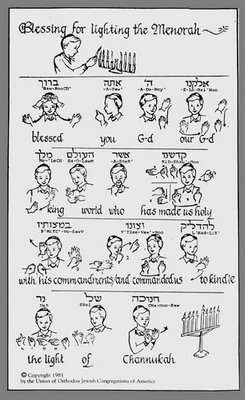
Chodesh Kislev tov, everyone. Woo hoo! 25 days until Chanukah! I have no deeper thoughts than that at the moment, but maybe I will if I get some sleep this weekend...? One can always hope.
Enjoy the directions for lighting Chanukah candles in American Sign Language, to the left here, couresy of the Union of Orthodox Jewish Congregations (most commonly known as the "OU," the people who supervise food production and then put kosher symbols on packaged food).
Addendum: Why is a male child depicted on the card? I should think, even in 1981, that (at least Ashkenazi) Jewish girls were lighting Chanukah candles along with their brethren. (See Babylonian Talmud Shabbat 23a for a reason why. See Shulchan Aruch Orach Chaim 17:2 and 589:6 for why Sephardi women don't make brachot over time-bound mitzvot, even ones they are obligated in, if there is a man around to fulfill their obligation. See this for some elucidation on this esoteric topic.)
Labels: gender, Rosh Chodesh, Torah (broadly defined)


